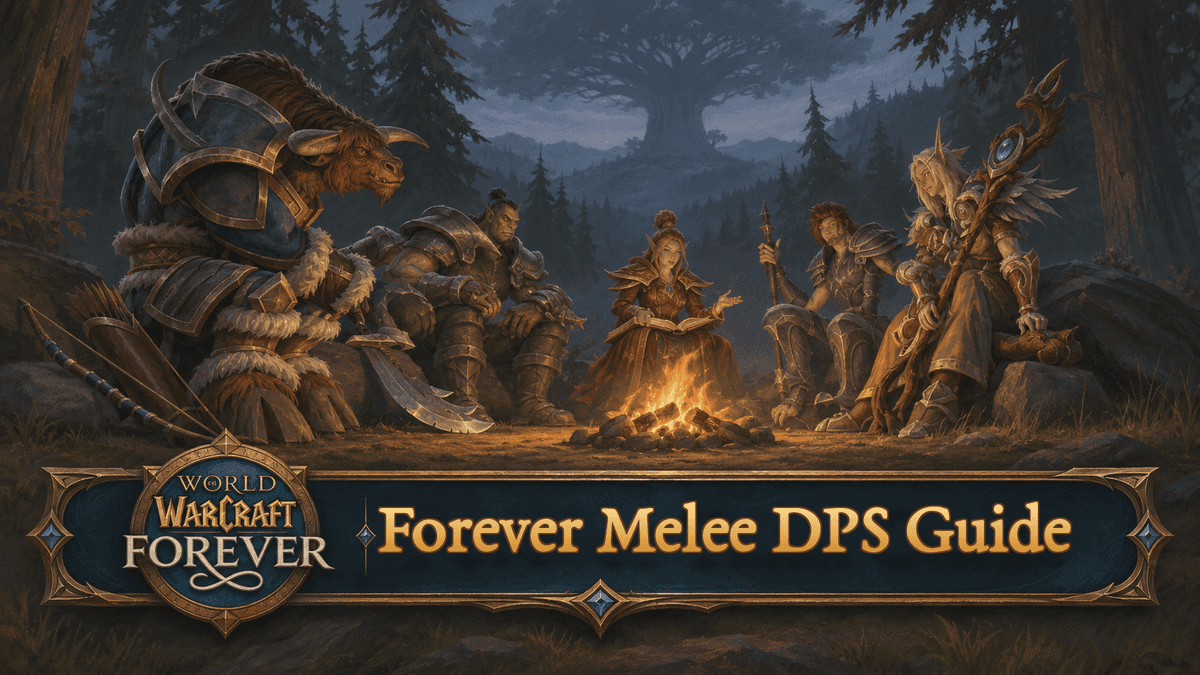
WoW Forever Melee DPS Guide - Every Melee Spec Explained
Dariz · 11/11/2026
WoW Forever has more melee identities than Classic ever did, and that is exactly why reducing them to one DPS ranking is not very helpful. Arms and Fury are both Warriors but solve fights differently. Enhancement is half weapon fighter, half support caster. Feral is a resource-and-shapeshift spec. Rogue gives you three different answers to the same pair of daggers. Survival Hunter barely agrees with the word 'melee' at all because its optimal fantasy is stepping in and out of range on purpose.
Why this is not a tier list:
WoW Forever is one week old. WoWStats' November 11 snapshot tracks more than 417,000 public profiles, but only 85 in that sample are level 60. That is nowhere near enough mature raid data to pretend there is a final endgame ranking. This guide focuses on toolkit, playstyle, strengths, weaknesses and role fit instead.
All recommendations below are written for the live game as of November 11, 2026. Blizzard has already started Tuesday class tuning, so exact coefficients can move faster than the underlying role identity.
November 10 hotfix:
Enhancement Shaman was retuned so Strength/Attack Power is the intended gearing direction again. Stormstrike returned to 100% weapon damage with an 8-second cooldown, Mental Dexterity was reduced, and Maelstrom Weapon's proc model changed. Any Enhancement guide written before November 10 needs that context.
Melee DPS Specs at a Glance
- Arms Warrior — Core playstyle: Two-handed, proc/reactive — Big strength: Two-target cleave and weapon impact — Big weakness: Gear/weapon dependence
- Fury Warrior — Core playstyle: Fast Rage/dual-wield pressure — Big strength: Burst, Execute and cleave — Big weakness: Needs uptime and resource flow
- Retribution Paladin — Core playstyle: Holy melee hybrid — Big strength: Utility + active Seal/Holy Strike loop — Big weakness: Mana and lower mobility
- Enhancement Shaman — Core playstyle: Weapon/spell hybrid — Big strength: Totems, imbues, reactive procs — Big weakness: Recent tuning means gearing is still settling
- Feral Cat — Core playstyle: Energy/combo-point bleed melee — Big strength: Mobility, stealth, hybrid flexibility — Big weakness: Limited Cat AoE and form/mana management
- Assassination Rogue — Core playstyle: Poison/dagger pressure — Big strength: Sustained poison damage — Big weakness: Ramp and dagger dependence
- Combat Rogue — Core playstyle: Classic weapon DPS — Big strength: Reliable sustained damage and utility — Big weakness: Weapon-type/gear dependence
- Subtlety Rogue — Core playstyle: Bleed/stealth technical melee — Big strength: Control and flexible PvE redesign — Big weakness: More execution and setup
- Survival Hunter — Core playstyle: Ranged-melee weaving — Big strength: Dynamic damage, traps and mobility — Big weakness: Dead-zone/timing complexity
Arms Warrior
Arms is the spec for people who want every weapon upgrade to feel personal. Forever improves Rend, guarantees more Overpower access through Bloodthrill, consolidates weapon specializations and gives Slam a much more usable place in the kit.
- Two-handed reactive melee — Best fit: Cleave lovers, big weapon hits, PvP crossover — Main friction: Weapon dependence and limited self-sustain
Strengths
- Excellent two-target cleave through Sweeping Strikes, Whirlwind and Cleave interactions.
- Two-handed weapon upgrades produce very visible power gains.
- Mortal Strike keeps iconic healing-reduction utility.
- Relatively easy core loop with room for stance/position mastery.
Weaknesses
- A weak weapon makes the entire character feel worse.
- Limited self-healing compared with hybrids.
- Staying on target matters; melee downtime hurts.
- Can feel slower outside combat because Warrior sustain is not a strength.
Dungeons vs. Raids
Arms is great when encounters give you one or two priority targets and enough uptime to keep swinging. Dungeons reward its cleave and control. Raids reward the ability to turn a strong two-hander into reliable boss pressure without requiring an elaborate ramp.
Recommended Talent Direction
Start with a deep Arms setup built around Mortal Strike, Weaponmaster, Bloodthrill and Sweeping Strikes, then spend remaining points on Rage/crit support. The exact split is less important than preserving the two-handed core.
Open the Warrior WoW Forever Talent Calculator on WoWStats.
Fury Warrior
Fury is the faster Warrior. Normalized Rage generation makes the spec less absurdly gear-dependent than old Classic Fury while preserving the feeling of turning crits, cooldowns and Execute windows into a long sequence of angry button presses.
- Fast dual-wield Rage DPS — Best fit: High uptime, cleave, burst windows — Main friction: Uptime and Rage still define the spec
Strengths
- Very strong cleave profile.
- Powerful cooldown and Execute-phase damage.
- Normalized Rage makes early gearing less punishing than old Classic Fury.
- High tempo for players who dislike slow two-handed pacing.
Weaknesses
- Still wants consistent melee uptime.
- Dual-wield gearing can be more demanding than one big weapon.
- High activity level is less relaxing than simpler specs.
- Less group utility than Paladin/Shaman hybrids.
Dungeons vs. Raids
Fury is at home in dungeons where cleave and constant targets feed its rhythm. In raids, it wants long uptime windows and bosses that let it keep attacking. If Arms is about each hit feeling heavy, Fury is about never wanting to stop swinging.
Recommended Talent Direction
Go deep Fury around the spec's Rage, Flurry/crit and cooldown tools, with outside-tree points supporting weapon damage and resource flow. Current verified Fury guidance is built around the normalized Rage model rather than old Classic assumptions.
Open the Warrior WoW Forever Talent Calculator on WoWStats.
Retribution Paladin
Retribution is no longer the 'auto-attack and wait' joke. Consecration and Kings are baseline, Holy Strike gives you another real melee button, Judgement no longer eats your Seal, and the tree has multiple answers to old mana problems.
- Holy melee support DPS — Best fit: Players who want damage plus group utility — Main friction: Mana and limited mobility
Strengths
- Far more active rotation than Classic Retribution.
- Excellent group utility through Blessings, Auras, stuns and emergency support.
- Can use many stats while leveling and values strong weapon DPS heavily.
- Flexible build space around Seal and Holy interactions.
Weaknesses
- Mana can still punish careless Consecration/spell use.
- Mobility remains limited compared with Feral, Rogue or Hunter.
- Damage value is tied to weapon quality and encounter uptime.
- Utility buttons add responsibility even when you only signed up to DPS.
Dungeons vs. Raids
Retribution feels especially good in dungeons because its utility has many chances to matter. In raids, it is a melee DPS that can solve problems other specs cannot, which is often more valuable than a small paper-DPS difference.
Recommended Talent Direction
Build deep Retribution around the active Seal/Holy Strike game. Current live guides offer multiple endgame variants, including Twist of Light and Holy Shock-flavored setups, so the right 51-point tree depends on whether you want maximum personal damage or more hybrid support.
Open the Paladin WoW Forever Talent Calculator on WoWStats.
Enhancement Shaman
Enhancement is the melee spec for players who enjoy being half damage dealer and half group infrastructure. Weapon imbues, Totems, shocks, Stormstrike and Maelstrom procs all compete for your attention, and the November 10 hotfix deliberately pushed the spec back toward Strength and Attack Power gear.
- Weapon/spell hybrid with Totems — Best fit: Utility-heavy melee and reactive players — Main friction: Mana, proc variance and fresh tuning
Strengths
- Exceptional group utility through Totems.
- Weapon imbues and Totems can now work together, including Windfury Weapon plus Windfury Totem.
- Strong hybrid fantasy with damage, interrupts and emergency healing.
- Maelstrom creates reactive casting decisions instead of a pure auto-attack loop.
Weaknesses
- One of the freshest-tuned specs, so old stat guides are already obsolete.
- Mana and hybrid spell use add another resource pressure.
- Proc-heavy gameplay can feel inconsistent.
- You are expected to manage Totems, not just your damage buttons.
Dungeons vs. Raids
Enhancement is extremely valuable in groups even before personal DPS enters the conversation. Dungeons reward interrupts, Totems and emergency support; raids reward the same utility plus sustained melee contribution. The spec is a poor choice for someone who wants to ignore the rest of the party.
Recommended Talent Direction
Use a deep Enhancement tree centered on Stormstrike, Maelstrom Weapon and melee-support talents, but build and gear for Strength/Attack Power first after the November 10 hotfix. The WoWStats tree snapshot predates those exact value changes, so use the calculator for structure and verify current tooltips in game.
Open the Shaman WoW Forever Talent Calculator on WoWStats.
Live-tuning note:
November 10 changed Stormstrike, Mental Dexterity and Maelstrom Weapon. Do not copy pre-hotfix Spell Power gearing advice.
Feral Druid - Cat DPS
Cat is the mobility-and-flexibility melee. You manage Energy, combo points and bleeds, but you also carry Bear Form, self-healing, stealth, Rebirth and group buffs in the same character.
- Energy/combo-point bleed melee — Best fit: Mobile players who value hybrid flexibility — Main friction: Limited Cat AoE and shapeshift management
Strengths
- Excellent mobility and access to stealth.
- Strong self-healing and low downtime.
- Can flex into Bear Form when the group needs emergency durability or an off-tank.
- Powerful raid utility through Druid support tools.
Weaknesses
- Cat Form AoE is limited.
- Shapeshifting and healing spend Mana outside your Energy loop.
- More systems to understand than a pure weapon DPS.
- Hybrid builds can trade a few percent of Cat damage for tank flexibility.
Dungeons vs. Raids
Cat is strong for players who like solving mechanics with movement and utility rather than only maximizing turret uptime. Dungeons reward the flexibility; raids can reward either a pure Cat or a hybrid Feral depending on whether an extra off-tank is useful.
Recommended Talent Direction
Go deep Feral for Cat damage, then use remaining points for resource/utility support. Current Feral theorycraft shows a meaningful but not enormous gap between full Cat and hybrid Cat/Bear, so build around your raid job instead of assuming one tree is mandatory.
Open the Druid WoW Forever Talent Calculator on WoWStats.
Assassination Rogue
Assassination is the poison Rogue. Mutilate and Venom push the spec toward daggers and poison throughput, while Forever's smoother Energy ticks and poison Attack Power scaling make the rotation less clunky than old Classic Rogue.
- Poison/dagger sustained DPS — Best fit: Players who enjoy DoT/poison maintenance — Main friction: Ramp and dagger commitment
Strengths
- Strong poison identity and sustained damage.
- Smoother Energy regeneration than Classic.
- Poisons scale with Attack Power and interact with new talents.
- Rogue control, stealth and interrupts remain excellent.
Weaknesses
- Wants daggers once the core Assassination package comes online.
- Poison/ramp value is lower on targets that die instantly.
- Less forgiving if you dislike maintaining weapon/poison setup.
- Melee uptime still matters despite damage-over-time elements.
Dungeons vs. Raids
Assassination is comfortable on bosses and durable targets where poisons get time to work. In dungeons, it remains useful through Rogue control, but the most disposable trash packs may die before the full poison plan matters.
Recommended Talent Direction
Build deep Assassination around Mutilate, Venom, poison amplification and Energy support. Outside-tree points should reinforce sustained uptime rather than turn the spec into a weaker Combat clone.
Open the Rogue WoW Forever Talent Calculator on WoWStats.
Combat Rogue
Combat is the most recognizable Classic Rogue: weapon damage, Slice and Dice, reliable Energy spending and very little need to explain your identity to the group. Forever smooths Energy regeneration and broadens weapon options without replacing the core.
- Reliable weapon-based sustained DPS — Best fit: Straightforward Rogue PvE and dungeon play — Main friction: Weapon dependence
Strengths
- Low-downtime, dependable sustained damage.
- Excellent Rogue utility and control.
- Axes expand weapon choices in Forever.
- Smooth Energy ticks make the spec feel more responsive.
Weaknesses
- Weapon quality and type matter a lot.
- Less distinctive burst fantasy than Subtlety or poison specialization than Assassination.
- Still melee: bad boss movement can ruin uptime.
- Hack and Slash-style choices can constrain ideal weapon combinations.
Dungeons vs. Raids
Combat is the easiest Rogue spec to recommend to someone who wants to play Rogue first and specialization second. It is excellent in dungeons, reliable on bosses and easy to understand without being trivial to optimize.
Recommended Talent Direction
Go deep Combat for sustained weapon damage, Blade Flurry/Adrenaline-style tempo and weapon synergies, then spend remaining points on Assassination efficiency or utility depending on gear.
Open the Rogue WoW Forever Talent Calculator on WoWStats.
Subtlety Rogue
Subtlety is no longer just the tree people open when they want to annoy someone in PvP. Forever adds PvE damage support, bleed interactions and deep-tree choices while preserving the control-heavy Rogue identity.
- Technical bleed/control melee — Best fit: Players who enjoy setup, control and optimization — Main friction: More execution than Combat
Strengths
- Expanded PvE damage identity compared with Classic.
- Excellent control and stealth toolkit.
- Hemorrhage/dagger interactions create build texture.
- Shank gives all Rogues another Energy-management lever.
Weaknesses
- More setup and execution than Combat.
- Some strengths are less visible on simple tank-and-spank encounters.
- Bleed-focused value can depend on target lifespan.
- Easy to play adequately, harder to extract every bit of value.
Dungeons vs. Raids
Subtlety is attractive when you want Rogue utility plus a more technical damage loop. It is not only a PvP spec anymore, but it still rewards players who like controlling the pace of a fight rather than tunneling one target.
Recommended Talent Direction
Build deep Subtlety around its new PvE damage/bleed tools, then use outside points for efficiency and crit. Do not assume old Classic Subtlety talent templates map cleanly onto Forever.
Open the Rogue WoW Forever Talent Calculator on WoWStats.
Survival Hunter
Survival is the strangest melee spec in Forever because the best version of the fantasy may not stay in melee. The live design rewards weaving: fire a shot, step into melee for Raptor Strike/Mongoose Bite/Strider Kick or a trap, then step back out before you clip your next Auto Shot.
- Ranged-melee weaving Hunter — Best fit: High-movement players who enjoy timing — Main friction: Dead-zone, weapon loadout and timing complexity
Strengths
- Very dynamic gameplay with both ranged and melee damage.
- Strong mobility and trap interaction.
- Pet remains useful for solo safety and utility.
- Can play weave or more melee-heavy variants depending on preference.
Weaknesses
- Dead-zone positioning creates real execution pressure.
- You care about both melee and ranged weapon quality.
- Poor timing can clip Auto Shots and erase the reason you are weaving.
- More keybinds and resource considerations than BM/MM Hunter.
Dungeons vs. Raids
Survival is fantastic for players who want a spec that feels unique to Forever. Dungeons give you many trap and movement opportunities; raids reward clean movement and perfect weave timing. If you hate stepping in and out of range on purpose, this is probably not your spec.
Recommended Talent Direction
Current November 11 Survival guidance favors deep Survival with support in Marksmanship/Beast Mastery depending on whether you emphasize weaving, mana or pet support. A fresh leveling/general build uses 7/13/31; endgame variants can shift support points while keeping the deep Survival identity.
Open the Hunter WoW Forever Talent Calculator on WoWStats.
Which Melee DPS Fits Your Playstyle?
- Big two-handed hits and cleave — Try...: Arms Warrior
- Fast melee and Execute windows — Try...: Fury Warrior
- Damage plus party-saving utility — Try...: Retribution Paladin
- Totems, procs and hybrid spell use — Try...: Enhancement Shaman
- Mobility, stealth and hybrid flexibility — Try...: Feral Cat
- Poisons and sustained pressure — Try...: Assassination Rogue
- Classic reliable weapon DPS — Try...: Combat Rogue
- Technical control and bleed gameplay — Try...: Subtlety Rogue
- Constant movement between ranged and melee — Try...: Survival Hunter
Melee DPS Talent Calculator Note
The WoWStats calculators use the November 3 talent-tree snapshot. The November 10 hotfix is especially important for Enhancement Shaman, and Blizzard also adjusted Hunter pet values. Use the calculator to plan legal point distributions, but check live spell/talent numbers before treating a tooltip as final.
WoW Forever Melee DPS FAQ
What is the easiest melee DPS in WoW Forever?
Combat Rogue and Retribution Paladin have straightforward core loops, although Paladin carries more group-utility responsibility. Arms is also easy to understand but heavily dependent on weapon quality.
Which melee spec is the most mobile?
Feral Cat and Survival Hunter are natural mobility picks; Rogue also has excellent control and positioning tools.
Is Survival Hunter really melee?
It can be played melee-heavy, but current Forever design strongly supports ranged-melee weaving, so it is better described as a hybrid melee/ranged DPS spec.
Did Enhancement Shaman change after launch?
Yes. The November 10 hotfix pushed Enhancement back toward Strength/Attack Power gear and changed Stormstrike, Mental Dexterity and Maelstrom Weapon.
Which Rogue spec should a beginner play?
Combat is the cleanest starting point. Assassination is better if poisons appeal to you; Subtlety is the more technical setup/control option.
Should I choose melee from DPS rankings?
Not this early. There is very little mature level-60 data. Choose a playstyle first and revisit tuning once raid logs are meaningful.
Final Thoughts
Melee in Forever is unusually healthy as a design space because the specs do not all solve the same problem with different-colored buttons. Pick the one whose failure state you can tolerate. Arms hates bad weapons. Enhancement asks you to manage a group toolkit. Survival asks you to move correctly. Rogue asks you to care about setup. Those differences matter more than a launch-week tier letter.